Launching a Solana token is easy. Building real liquidity and believable volume is not. This playbook shows how to structure LPs and use bots the smart way.
You launch your Solana token, watch the first buys roll in, and for a few minutes it feels like you’ve made it.
Then the chart flatlines.
No volume. No new wallets. DexScreener page goes quiet. Even your friends stop asking “how’s the token doing?”
If that sounds familiar, you don’t have a “marketing problem” yet. You have a liquidity and volume problem.
In this guide, we’ll break down a practical Solana liquidity playbook you can actually run, even if you’re not a quant or a market maker. You’ll see how smart LP design + realistic volume bots can turn a dead chart into something real traders are willing to touch.
TL;DR – Solana Liquidity & Volume in One Page
- Thin liquidity and choppy volume scare off serious traders faster than a bad website.
- Aim for tight spreads (<2%), realistic volume, and consistent order flow instead of random pumps.
- Anchor your pool with enough liquidity (often 5–15% of FDV on small caps) so traders can move in and out.
- Use a Solana volume bot to simulate healthy order flow, not to fake 100x pumps.
- Monitor everything from a live dashboard and adjust your LP, volume, and budgets daily.
We’ll walk through how to do all of that step‑by‑step.
Why Liquidity Matters More Than Hype on Solana
On Solana, transactions are cheap and fast. That’s great for memes, but it also means traders can dump your token in seconds if your liquidity looks bad.
Let’s simplify what “good liquidity” actually means for your token:
- Tight spreads – The gap between best bid and best ask is small.
- Low price impact – A 1–3 SOL buy shouldn’t move price 10–20%.
- Depth on both sides – There are meaningful buy and sell orders.
If a trader sees that a 2 SOL buy moves price 8–12%, they instantly think:
“If I buy this, I’ll never be able to sell without nuking the chart.”
That’s why good liquidity often beats good memes.
How Much Liquidity Is “Enough” on Solana?
There’s no perfect number, but you can use simple rules of thumb. For smaller Solana tokens (say $10k–$200k FDV):
- LP depth: Often 5–15% of FDV in the main pool is a good starting zone.
- Price impact: A 1–3 SOL trade should move price by <2–4%.
- Daily volume: Healthy volume is often 20–150% of LP size on active days.
Example:
- FDV: $80,000
- Target LP: $8,000–$12,000
- Target daily volume: $4,000–$18,000 (50–150% of LP)
That’s the kind of environment where traders feel they can play without getting trapped.
If you want to go deeper into how volume bots fit into this picture, bookmark the full Solana Volume Bots 2025 Guide for later.
The Solana Liquidity & Volume Playbook (Step‑By‑Step)

Let’s turn this into something you can actually implement over the next 7–14 days.
We’ll assume:
- You’ve already launched your token.
- You either came from PumpFun, Moonshot, or a custom launch.
- You’re listed (or planning to list) on a Solana DEX like Raydium or Orca.
If you’re still fuzzy on DEX basics, the official docs for Solana and Raydium are worth skimming.
Step 1: Define Your Liquidity & Volume Targets
Before touching bots or LP, you need targets. Most founders skip this and just “add some liquidity and hope.”
Ask yourself:
-
What FDV / market cap are you aiming for in the next 7–14 days?
Example: from $20k now to $60k. -
How much liquidity are you willing to lock or allocate?
Example: $5k–$8k in the main pool. -
What daily volume do you want to show on DexScreener?
Example: $3k–$10k daily, with bigger spikes around news.
Then sanity‑check the ratios:
- LP as % of FDV: 8k LP / 60k FDV ≈ 13% → reasonable.
- Daily volume as % of LP:
- Low day: 3k / 8k = 37% → believable.
- High day: 10k / 8k = 125% → aggressive but realistic for hyped days.
You’ll use these targets to program your volume curves later.
Step 2: Design Your Liquidity Pool the Right Way
Next, you want your pool structure to look like something a real trader expects. That means making smart choices on pair, size, and concentration.
2.1 Choose the Right Pair
For most small/mid Solana tokens, focus on:
- SOL pair – Great for degen flow and meme traders.
- USDC pair – Better for more serious investors and clear dollar pricing.
Early on, a single, deeper pool usually beats 3–4 tiny fragmented pools. A lot of tokens get wrecked by splitting $8k into 3 pools, leaving each one untradeable.
2.2 Decide How Much LP to Start With
If you start with too little LP, early buyers get huge price impact and later buyers can’t enter. If you start with too much LP, the chart barely moves and nobody cares.
Simple starting framework:
- Below $20k FDV: LP can be 10–25% of FDV (higher to avoid wild swings).
- $20k–$100k FDV: LP in the 5–15% range.
- Above $100k FDV: Lower percentages are fine if volume is consistent.
You can always add liquidity gradually as your holder count and daily volume grow.
2.3 Avoid Common LP Mistakes
Watch out for these red flags that scare traders:
- Super thin pools – $1,500 LP for a token that claims “$100k+ MC.”
- Insane price impact – 1 SOL moves chart 15–30%.
- Locked LP but dead volume – technically “safe,” but nobody cares.
If your chart already looks like that, don’t panic. The second half of this playbook is exactly how you fix the narrative.
Step 3: Layer In Smart, Realistic Volume
Once the pool is set, you need order flow. That’s where a Solana volume bot comes in—but not for the reason most people think.
The goal isn’t to fake a 100x green candle. The goal is to simulate the kind of trading pattern real humans would generate, so:
- DexScreener shows believable volume.
- Spreads stay tight.
- Entries and exits feel smooth.
To understand the difference between healthy automation and dangerous spam, it’s worth skimming the Complete Crypto Volume Bot Guide when you have time.
Manual vs Bot‑Assisted: What’s Actually Better?
Here’s how manual trading compares to using a volume bot for liquidity support:
| Approach | Pros | Cons | |---------------------------------|-------------------------------------------|------------------------------------------------| | Manual market‑making only | Full control, no bot risk | Inconsistent, time‑draining, easy to mess up | | Pure hype, no structure | Sometimes goes viral by luck | 99% die with dead charts and bad liquidity | | Bot‑assisted (smart settings) | Consistent flow, realistic volume curves | Needs planning, discipline, and risk limits |
You’re aiming for the bot‑assisted lane: human strategy + automated execution.
3.1 Designing Your Volume Curve
Think of your daily volume like a heartbeat, not a flat line.
Most healthy charts have:
- Baseline volume – Constant, smaller trades throughout the day.
- Peaks – Higher volume around news, tweets, or community pushes.
- Quiet windows – Lower action during off‑hours (e.g. US night if your audience is Western).
For example, let’s say you target $6,000 daily volume:
- Baseline: $150–$300/hour most of the day.
- Three peaks: $600–$900/hour around your key time zones.
- Natural randomness: vary trade sizes from $20 to $400 equivalent.
With a tool like the Solana Volume Bot (see features at /features/solana-volume-bot), you can structure this kind of curve instead of clicking buys and sells by hand.
Step 4: Monitor, Adjust, and Don’t Be Lazy
Once you’ve got LP set and volume flowing, your job is not done. It just changes.
From here, your main job is to monitor metrics and tweak settings. Use a live dashboard (like the one at /dashboard) and keep an eye on:
- Spread – Aim for <2–3% between best bid and ask.
- Price impact – Check 1–3 SOL buy/sell impact on your DEX.
- Volume vs LP – Daily volume often looks best at 50–200% of LP.
- Holder growth – New wallets per day; combine with tools like the Holder Booster at /features/holder-booster.
If you’re not sure how much volume you can afford, run some quick numbers in a ROI tool like our /calculator before you overcommit.
You can learn more about the trade‑offs between automation and doing everything yourself in Volume Bot vs Manual Trading.
Using Solana Volume Bots Safely & Profitably
Let’s be clear: bots are a tool, not a magic pill. Used badly, they just burn your SOL and make your chart look botted.
Used properly, they can:
- Keep spreads tight.
- Maintain believable volume.
- Help you stay on DexScreener radars long enough for real buyers to show up.
Healthy vs Fake Volume: What Traders Actually Notice
Experienced traders don’t just look at “24h Volume.” They’re looking at patterns.
Red flags of fake or unhealthy volume:
- Perfectly even candles every 5 minutes, all day.
- 100% buys or 100% sells for hours at a time.
- Huge volume but no new holders (suspicious).
- Volume way above LP (e.g. $150k volume on $2k LP every day).
Signs of healthy activity:
- Mix of buys and sells with slight buy bias.
- Volume aligned with news, tweets, or community tasks.
- Gradually increasing holder count.
- Occasional spikes, but not every candle is a skyscraper.
The best bots—like what we build at Solana Volume Bot—are designed to make volume look human, not robotic. You can see more practical tips in our Volume Bot Tips & Best Practices.
Risk Management: Budgets, Runways, and ROI
You should never turn on a volume bot without a clear budget and runway.
Here’s a simple way to think about it:
-
Decide how many days you’re willing to support volume.
Example: 7–21 days. -
Decide what % of FDV you can spend on support.
Example: 3–10% of current FDV. -
Convert that into a daily support budget.
Example: FDV = $60k, budget = 6% = $3,600 over 14 days → about $257/day.
From there, pick a volume level where your expected PnL and social growth justify the cost. Our /pricing page breaks down how different plans and automation levels affect that math.
If your budget is tiny (say $50/day), it’s usually better to:
- Run lower but consistent volume for longer.
- Combine it with organic marketing and a holder incentive.
- Use tools like DexScreener Reactions at /features/dexscreener-reactions to make each real trader feel noticed.
A Realistic 7‑Day Liquidity & Volume Plan (Example)
Let’s run through an example so you can see how this looks in practice. Adjust the numbers for your own token, but keep the structure.
Starting point
- FDV: $30,000
- LP on Raydium: $4,500
- Daily budget for support: $150
- Goal in 7 days: $60,000 FDV, LP $6,000–$7,000, more stable chart
Day 1–2: Stabilize and test
- Top up LP from $4,500 → $5,500 if spread is too wide.
- Turn on Solana volume bot with:
- Target daily volume: $3,000–$4,000.
- More activity during your top two time zones.
- Watch price impact: aim for <4% for 1–2 SOL trades.
Day 3–4: Build a believable pattern
- Adjust bot so you have:
- Baseline during quiet hours: $80–$150/hour.
- Peaks around Twitter pushes: $400–$700/hour.
- Add a simple holder campaign powered by a tool like Holder Booster (e.g. tasks for new wallets).
- Monitor DexScreener: you want candles that look varied, not cookie‑cutter.
Day 5–7: Scale if the market responds
- If new wallets, Telegram members, and real buys are coming in:
- Gradually increase LP to $6,000–$7,000.
- Allow occasional volume spikes up to $6,000–$8,000/day.
- If it’s quiet:
- Reduce volume slightly.
- Focus on community + content for a few days.
Throughout the week, you should be watching your data from a dashboard like /dashboard and tweaking settings daily. That’s market‑making lite, and it’s exactly how you avoid burning your entire budget in 24 hours.
For a deeper dive into different bot strategies and tradeoffs, check our Solana Volume Bots 2025 Guide when you’re done here.
How Solana Volume Bot Fits Into Your Stack
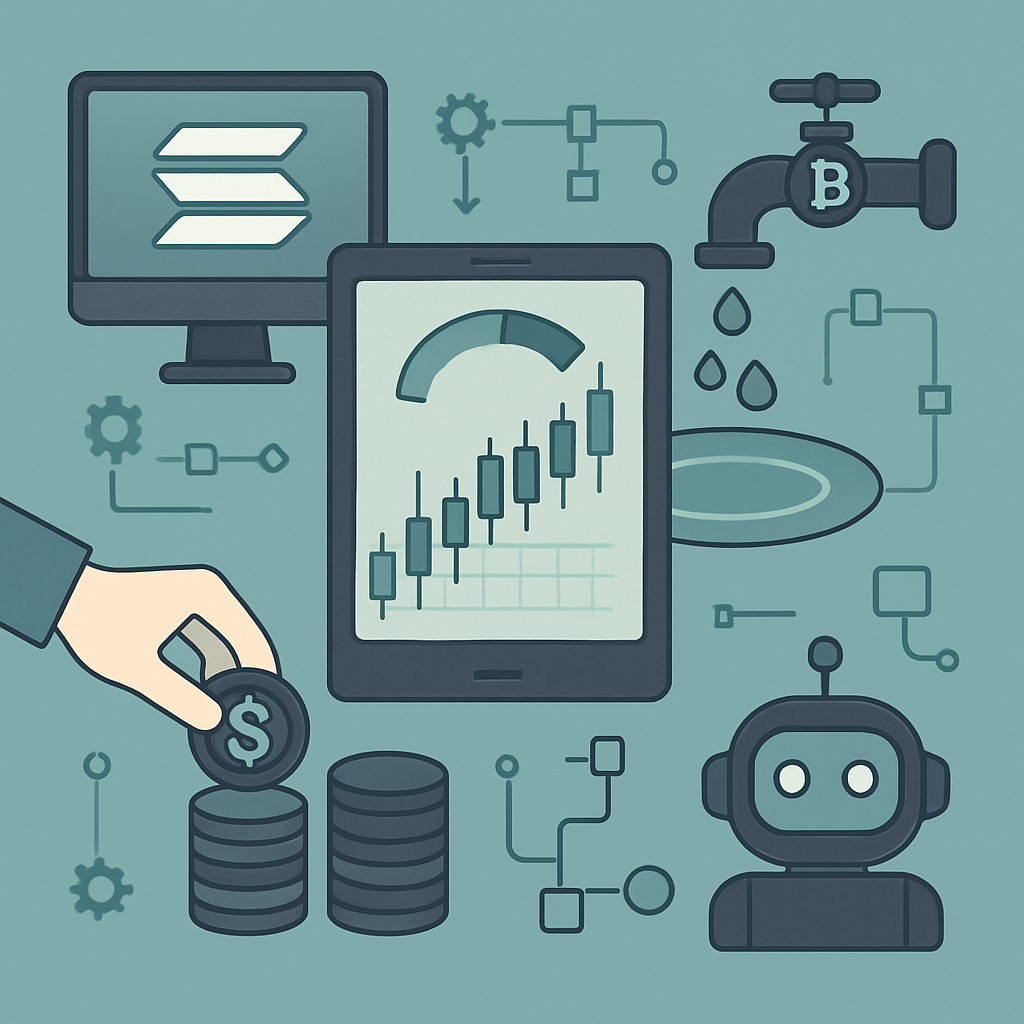
At this point, you might be thinking:
“Okay, I get the theory. What does this look like with real tools?”
Here’s how a setup using Solana Volume Bot features typically works for teams that treat their token like a real project.
Core Features You’ll Actually Use
Within the main product suite at /features, most Solana teams lean on:
-
Solana Volume Bot – For structured, realistic buy/sell flows.
See details at /features/solana-volume-bot. -
Holder Booster – To turn visitors and early traders into sticky wallets, instead of just pump‑and‑dump flow.
More at /features/holder-booster. -
DexScreener Reactions – To automatically react to trades and help the chart feel alive for new visitors.
See /features/dexscreener-reactions. -
Solana Rank Bot – To showcase holder and volume milestones in your Telegram/Discord, supporting social proof.
Check /features/solana-rank-bot.
Combined, this lets you:
- Set clear liquidity + volume targets.
- Automate execution.
- Track everything from a unified dashboard.
If you’re wondering whether you should stick to manual trading or lean into automation, the comparison in Volume Bot vs Manual Trading lays out the pros and cons in detail.
Planning Your Next 30 Days
Use this playbook to sketch a 30‑day plan:
- Days 1–3 – Fix LP problems and stabilize spreads.
- Days 4–10 – Turn on structured volume, connect Holder Booster, start daily updates.
- Days 11–20 – Adjust budgets based on real demand, refine volume curves.
- Days 21–30 – Decide whether to scale, sustain, or wind down support based on:
- Holder growth.
- Social traction.
- Organic volume.
Each phase should have:
- Clear LP targets.
- Daily volume ranges.
- A defined support budget.
Run the numbers with the /calculator, then pick a plan on /pricing that matches your ambition and risk tolerance.
If you want to go deeper into crypto volume automation beyond Solana only, the Complete Crypto Volume Bot Guide gives a chain‑agnostic overview.
Related Reading
If you found this playbook useful, these deep dives will help you sharpen your strategy:
Ready to Make Your Solana Chart Tradable Again?
You don’t need a CEX listing or a seven‑figure market‑making contract to make your Solana token feel alive. You just need structured liquidity, believable volume, and the discipline to manage it for a few weeks instead of a few hours.
If you’re serious about giving your token a real shot:
- Explore the full feature set at /features.
- Run your numbers with the /calculator.
- Pick a starting plan on /pricing.
- Connect your wallet and start tracking everything from /dashboard.
Treat your token like a small startup, not a lottery ticket. Your holders—and your future self—will thank you.
Ready to Boost Your Token?
Join thousands of successful projects using our advanced Solana Volume Bot platform. Increase your token's visibility, attract investors, and dominate the trending charts.

Edward Riker
Lead SEO Strategist
Veteran SEO strategist and crypto trading writer
Continue Reading
Discover more expert insights on Solana volume trading
Solana Token Marketing With Smart Volume Bots 2025
Launching a Solana token? Here’s how to use volume bots, liquidity, and holder growth tools together to market your token without nuking your reputation.
Real vs Fake Volume on Solana: Owner’s Playbook
Struggling to tell if Solana token volume is real or botted? Learn how to spot fake volume, avoid getting flagged, and use volume bots safely and profitably.
Pro Jupiter Volume Bot Strategies for Solana Tokens
Discover how to use a Jupiter volume bot to grow liquidity, stabilize price, and get your Solana token noticed on DEXs and trackers with realistic volume.